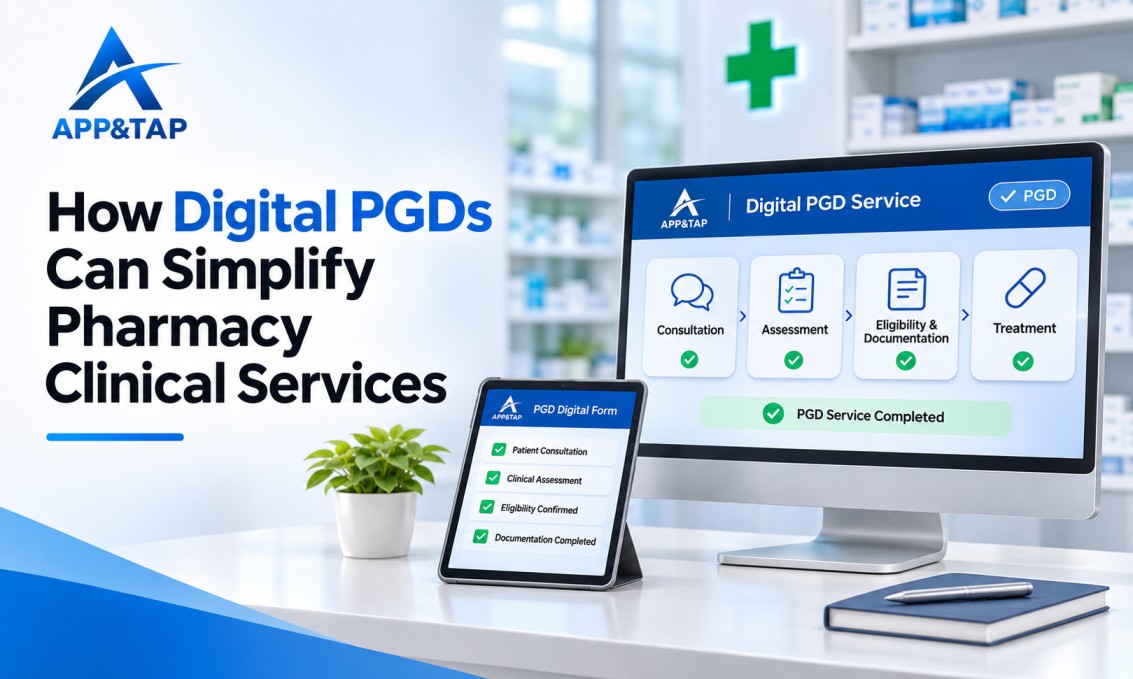
Community pharmacies are playing an increasingly important role in delivering accessible healthcare across the UK. From travel vaccinations and minor illness consultations to private healthcare services, pharmacies are expanding their clinical offerings to meet growing patient demand.
However, providing these services involves more than conducting consultations. Pharmacists must also manage patient assessments, clinical documentation, eligibility checks, and regulatory requirements.
These administrative responsibilities can take up valuable time, especially for independent pharmacies managing multiple services alongside their daily dispensing operations.
This is where digital Patient Group Directions (e-PGDs) can make a significant difference.
By replacing fragmented paper-based processes with structured digital workflows, electronic PGD solutions can help pharmacies streamline clinical administration, maintain organised records, and create a more efficient consultation experience.
1. What Are Digital PGDs?
A Patient Group Direction (PGD) is a legal framework that allows specified, authorised healthcare professionals to supply or administer certain medicines to eligible patients without an individual prescription.
PGDs are commonly used in appropriate healthcare services, including vaccinations and certain community pharmacy treatments.
A digital PGD, often referred to as an e-PGD, uses electronic systems to support the documentation, administration, and management of services delivered under an authorised PGD.
Rather than relying entirely on paper forms and manual filing, pharmacy teams can use digital platforms to manage aspects of the consultation process.
Depending on the system, these platforms may support:
Digital patient assessment forms.
Structured consultation workflows.
Recording of inclusion and exclusion criteria.
Electronic clinical documentation.
Secure management of consultation records.
Access to relevant PGD information.
Digital PGDs do not replace the legal requirements of a PGD or the professional judgement of the pharmacist. Instead, they help simplify the administrative processes involved in delivering eligible clinical services.
2. Reducing Paperwork and Manual Administration
Traditional paper-based clinical consultations can involve completing assessment forms, recording patient information, documenting treatment decisions, and filing records.
When pharmacies deliver several clinical services each day, these tasks can add to their administrative workload.
Digital PGD platforms can help streamline the process by allowing relevant consultation information to be recorded electronically.
This can reduce the need for handwritten forms and duplicated administrative tasks.
Key benefits include:
Less reliance on paper-based consultation forms.
Reduced time spent organising physical documents.
More structured recording of clinical assessments.
Easier retrieval of appropriately stored records.
Fewer administrative steps when managing routine consultations.
By reducing unnecessary paperwork, pharmacists can spend more time focusing on the patient rather than managing documents.
3. Making Clinical Consultations More Structured
Every clinical consultation requires appropriate patient assessment and professional decision-making.
When using a PGD, pharmacists must establish whether the patient meets the relevant inclusion criteria and whether any exclusion criteria apply.
A digital consultation system can support this process by presenting assessment questions in a clear, organised format.
For example, a digital questionnaire may guide the pharmacist through relevant information such as medical history, allergies, current medication, and treatment eligibility.
This helps create a consistent approach to gathering the information required for the service.
A structured digital workflow can help pharmacies:
Follow a more organised consultation process.
Record relevant patient responses consistently.
Reduce the likelihood of missing documentation fields.
Maintain clearer clinical records.
Support consistent workflows across pharmacy teams.
However, digital questionnaires are decision-support tools, not substitutes for clinical judgement. Pharmacists must still assess individual circumstances, identify contraindications, and make appropriate treatment or referral decisions.
4. Supporting Accurate Clinical Documentation
Maintaining accurate consultation records is an essential part of delivering safe pharmacy clinical services.
For services provided under a PGD, relevant records may include patient details, clinical assessment findings, medicines supplied or administered, consent, and the healthcare professional responsible.
Managing these records manually can become increasingly complex as consultation volumes grow.
Electronic PGD systems can make documentation more organised by providing structured fields for recording relevant clinical information.
Depending on the platform, this may help pharmacies maintain more consistent records and retrieve information when appropriately authorised.
Digital systems can also support governance processes, provided they are configured to meet applicable security, record-retention, and professional requirements.
Importantly, digital records must be protected through appropriate access controls and data security measures.
5. Improving the Patient Consultation Experience
Digitalisation is not only about reducing administrative work. It can also help create a smoother experience for patients.
Patients increasingly expect convenient ways to access healthcare services, including the ability to find information and book appointments online.
When digital clinical workflows are combined with online appointment booking, pharmacies can create a more connected patient journey.
For example, a patient seeking a travel health consultation could:
Visit their local pharmacy's website.
Explore available travel health services.
Book an appointment online.
Attend the pharmacy for a clinical assessment.
Receive appropriate advice and treatment, where clinically suitable.
During the consultation, the pharmacist can use a digital clinical system to document the assessment and any treatment provided under an applicable PGD.
This creates opportunities to reduce manual administration while maintaining a patient-focused service.
6. Helping Pharmacies Expand Private Clinical Services
Private clinical services offer independent pharmacies an opportunity to diversify their income and provide additional healthcare options to their communities.
Depending on the applicable legal framework, professional authorisations, and service arrangements, these may include:
Travel vaccinations.
Flu vaccination services.
Selected sexual health services.
Certain minor illness treatments.
Other eligible private clinical services.
As pharmacies introduce additional services, managing different consultation processes and documentation requirements can become more demanding.
Digital PGD platforms can help pharmacies organise eligible clinical workflows without relying entirely on separate paper-based processes.
This may make it easier to manage a wider range of services while maintaining a consistent approach to documentation.
For independent pharmacies, greater operational efficiency can also create opportunities to increase appointment capacity and develop additional revenue streams.
However, new services should always be introduced based on clinical suitability, staffing competence, appropriate authorisations, and applicable regulatory requirements.
7. Supporting Clinical Governance and Compliance
Clinical governance is fundamental to the safe delivery of pharmacy services.
According to the National Institute for Health and Care Excellence (NICE), PGDs must be used by appropriately trained, competent, named, and authorised healthcare professionals.
Electronic systems can support aspects of PGD administration, including maintaining appropriate documentation and managing access to relevant information.
For example, a suitable digital system may help pharmacies organise:
Records of completed consultations.
Relevant PGD versions and documentation.
Clinical assessment information.
Practitioner authorisation records, where supported.
Records required for monitoring and audit.
The NHS Specialist Pharmacy Service confirms that electronic processes can be used for individual PGD authorisation, provided the systems and processes meet the relevant requirements.
Using a digital platform does not automatically make a pharmacy compliant. The pharmacy and relevant provider organisations must still ensure that the PGDs, practitioners, clinical workflows, and records meet applicable requirements.
8. Giving Pharmacists More Time for Patient Care
One of the most valuable potential benefits of digital PGDs is the time they can help free up from administrative responsibilities.
Pharmacists already manage a wide range of tasks, including dispensing, medicine counselling, clinical consultations, and patient enquiries.
When consultation documentation and administrative processes are more organised, pharmacists may be able to spend less time on repetitive tasks.
This creates more opportunities to focus on:
Providing personalised healthcare advice.
Conducting thorough clinical assessments.
Supporting patients with treatment decisions.
Delivering additional pharmacy services.
Building stronger relationships with patients.
The objective is not to rush clinical consultations. It is to reduce unnecessary administrative work so that pharmacists can focus on delivering safe, effective, and accessible healthcare.
9. Connecting Digital PGDs With Pharmacy Websites and Patient Apps
Digital PGDs become particularly valuable as part of a wider pharmacy digital strategy.
A pharmacy website can help patients discover available services and book appointments, while a branded patient app offers another convenient way to access the pharmacy.
An electronic PGD platform can then support eligible clinical workflows when patients attend their consultations.
Together, these tools can create a more connected patient journey.
For example:
Discover a Service → Book Online → Attend Consultation → Complete Digital Clinical Documentation
This approach allows pharmacies to provide a convenient booking experience while simplifying the administrative elements of clinical service delivery.
Instead of treating online bookings, clinical consultations, and patient engagement as entirely separate activities, pharmacies can build a more coordinated digital experience.
How App&Tap Supports Digital Pharmacy Clinical Services
At App&Tap, we believe digital technology should make it easier for independent pharmacies to deliver healthcare services while strengthening their relationships with patients.
Our pharmacy-focused digital solutions help pharmacies build a professional online presence, make services more accessible, and support efficient clinical workflows.
Through our integration with PGDPro, App&Tap supports pharmacies looking to incorporate electronic PGD solutions into their clinical service delivery.
Alongside this, App&Tap offers:
Custom Pharmacy Websites: Promote available clinical services, provide essential information, and allow patients to book appointments online.
White-Label Pharmacy Apps: Give patients a branded mobile app through which they can access supported pharmacy services, request repeat prescriptions, and make bookings.
e-PGD Integration: Connect pharmacies with PGDPro to support eligible digital clinical consultation workflows.
Online Service Bookings: Help patients arrange appointments conveniently, reducing the need for routine telephone-based scheduling.
By combining digital patient access with supported clinical service technology, App&Tap helps independent pharmacies create a more accessible and organised healthcare experience.
Conclusion
As community pharmacies continue to expand their role in healthcare, efficient clinical administration is becoming increasingly important.
Digital PGDs offer a practical way to reduce reliance on paperwork, support structured consultations, improve record management, and simplify the administrative processes surrounding eligible pharmacy services.
For independent pharmacies, adopting the right digital tools can help create more organised workflows while supporting the delivery of additional clinical services.
When combined with pharmacy websites, online appointment bookings, and branded patient apps, electronic PGDs can form part of a more connected and convenient pharmacy experience.
Ultimately, the value of digitalisation lies in helping pharmacists spend less time on unnecessary administration and more time delivering quality patient care.
Simplify Your Pharmacy's Clinical Services With App&Tap
Looking to modernise your pharmacy and make private clinical services more accessible?
Discover how App&Tap's pharmacy websites, white-label patient apps, and PGDPro integration can support your pharmacy's digital growth.
Visit www.appandtap.com or Book a Demo to explore our digital pharmacy solutions.