
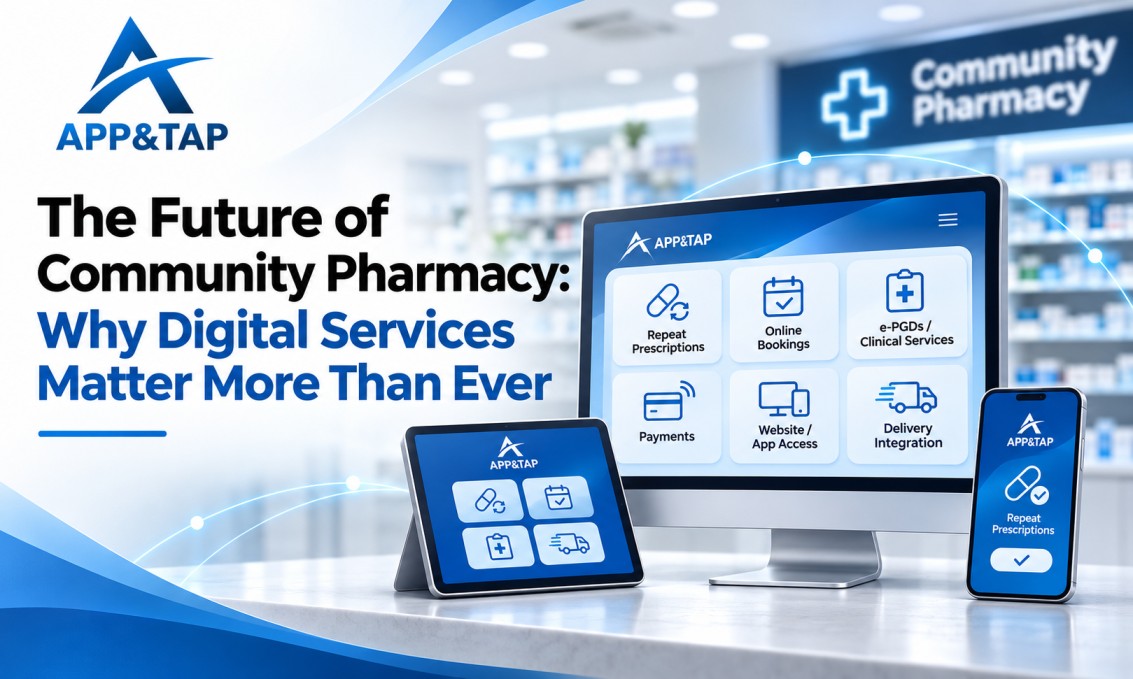
Community pharmacy in the UK is undergoing a significant transformation. What was once primarily associated with dispensing medicines is increasingly becoming a destination for accessible healthcare, clinical consultations, preventative services, and ongoing patient support.
As the healthcare landscape evolves, so do patient expectations. People want convenient access to healthcare, shorter waiting times, online appointment bookings, and the ability to manage their prescriptions without unnecessary telephone calls or visits.
For independent pharmacies, adapting to these expectations is becoming increasingly important.
Digital pharmacy services are no longer simply an additional convenience. They are becoming an essential part of how community pharmacies operate, engage with patients, and prepare for the future.
From branded pharmacy apps and professional websites to digital consultations and electronic clinical workflows, technology is creating opportunities for pharmacies to improve efficiency, strengthen patient relationships, and expand their services.
1. Community Pharmacy Is Moving Beyond Dispensing
Community pharmacies have long been trusted healthcare providers, offering advice, medicines, and essential support to their local communities.
However, their role is expanding.
Across England, services such as Pharmacy First, vaccinations, contraception consultations, and other clinical services are helping pharmacies take on a broader role in primary healthcare.
The NHS 10 Year Health Plan for England also outlines a shift towards neighbourhood healthcare, preventative services, and greater use of digital technology.
In October 2026, independent prescribing was introduced into England's Community Pharmacy Contractual Framework, further supporting the development of pharmacy-led clinical services.
This evolution creates new opportunities, but also brings additional operational responsibilities.
As pharmacies offer more services, they need efficient ways to manage appointments, patient enquiries, clinical documentation, and communication.
Digital solutions can help pharmacies manage this growing workload without allowing administrative tasks to overwhelm their teams.
2. Patients Expect Healthcare to Be Accessible Online
Digital convenience has become part of everyday life.
People regularly use mobile apps to manage banking, shopping, appointments, and other essential services. Healthcare is increasingly becoming part of the same digital experience.
For community pharmacies, this means patients may expect to access services online rather than relying entirely on telephone calls or face-to-face enquiries.
A modern pharmacy website or branded patient app can provide convenient access to:
Repeat prescription requests.
Online appointment bookings.
Pharmacy service information.
Digital payments.
Online pharmacy product shopping.
Pharmacy contact information.
These services allow patients to interact with their pharmacy at a time that suits them, even outside normal opening hours.
While clinical consultations and dispensing still require appropriate professional involvement, digital platforms can make the initial patient journey more convenient.
For independent pharmacies, this accessibility can become an important factor in attracting and retaining patients.
3. Branded Pharmacy Apps Are Strengthening Patient Relationships
Independent pharmacies have always benefited from strong relationships with their local communities.
Patients often value knowing their pharmacist and receiving personalised advice from someone they trust.
A white-label pharmacy app allows pharmacies to extend that relationship into the digital world.
Unlike generic platforms, a branded pharmacy app features the pharmacy's own name, logo, and identity.
This helps patients recognise and connect with their chosen pharmacy whenever they use the app.
For example, a patient who regularly requests repeat prescriptions through their local pharmacy's app may also discover additional services such as travel vaccinations or blood pressure checks.
Over time, these convenient interactions can help strengthen familiarity and encourage ongoing engagement.
A branded pharmacy app can support:
Stronger pharmacy brand recognition.
Convenient access to repeat prescriptions.
Improved awareness of available services.
Easier appointment bookings.
More consistent digital patient engagement.
For independent pharmacies competing with large pharmacy chains and online providers, combining personalised care with digital convenience can be a valuable advantage.
4. Pharmacy Websites Are Becoming Essential Digital Gateways
A pharmacy website is no longer just an online page displaying opening hours and contact details.
A modern pharmacy website can act as a digital gateway connecting patients with available healthcare services.
For example, someone searching online for travel vaccinations or a private pharmacy consultation may discover a local pharmacy through Google.
If that pharmacy has a professional website with clear service information and convenient booking options, the patient can explore the service and arrange an appointment.
Without a strong digital presence, pharmacies risk missing opportunities to reach patients who increasingly search for healthcare services online.
An effective pharmacy website can help:
Improve visibility in local online searches.
Promote NHS and private clinical services.
Allow patients to book appointments online.
Provide accessible healthcare information.
Support online product purchases.
Connect patients with a branded pharmacy app.
The future pharmacy website is not simply an information page. It is a platform that helps convert online interest into meaningful patient engagement.
5. Digital Clinical Services Are Supporting Pharmacy Growth
As community pharmacies expand their clinical offerings, managing consultations efficiently becomes increasingly important.
Private healthcare services can provide opportunities for pharmacies to diversify their income and make better use of their clinical expertise.
However, delivering these services involves administrative responsibilities such as managing appointment bookings, recording assessments, documenting treatment decisions, and maintaining appropriate clinical records.
Digital consultation systems and electronic Patient Group Directions (e-PGDs) can help simplify eligible clinical workflows.
Depending on the system and service, these solutions may support:
Structured digital consultation forms.
Recording patient assessment information.
Documenting eligibility criteria.
Organising clinical records.
Reducing reliance on paper-based processes.
Digital PGDs do not replace the clinical judgement of pharmacists or the legal requirements governing PGD services. Instead, they provide tools to help manage associated administrative processes.
When combined with online bookings, digital clinical systems can support a more coordinated patient journey, from booking an appointment to completing the consultation.
For independent pharmacies looking to expand their private services, these technologies can become an important part of a sustainable growth strategy.
6. Automation Can Reduce Administrative Pressure
One of the biggest challenges facing community pharmacies is balancing clinical responsibilities with everyday administrative work.
Pharmacy teams manage repeat prescription enquiries, appointment scheduling, telephone calls, patient communications, and other routine tasks alongside dispensing and clinical care.
Many of these processes can be made more efficient through digital technology.
For example:
Online Repeat Prescription Requests
Patients can submit eligible repeat prescription requests digitally, reducing reliance on telephone-based ordering. Requests remain subject to the relevant GP authorisation processes.
Online Appointment Bookings
Patients can book available pharmacy services through a website or app, reducing the need for staff to manually arrange every appointment.
Digital Consultation Forms
Structured electronic forms can help organise the information required for eligible clinical consultations.
Automated Patient Notifications
Where supported by connected systems, patients can receive updates about prescription collections or deliveries without pharmacy staff having to send every message manually.
Individually, these improvements may seem small. However, reducing repetitive tasks across several workflows can make a meaningful difference to day-to-day pharmacy operations.
The objective is not to replace pharmacy professionals with technology. It is to give them more time to focus on patients.
7. Connected Pharmacy Technology Is the Next Step
Digital transformation becomes more effective when pharmacy systems work together.
A pharmacy may use separate systems for patient bookings, repeat prescription requests, clinical consultations, dispensing, and delivery management.
When these systems operate independently, staff may need to transfer information manually or repeat administrative steps.
Connected digital solutions can help create more organised workflows and reduce unnecessary duplication.
For example, a pharmacy could provide patients with a branded app for prescription requests, a website for service bookings, and a delivery platform for managing medication deliveries.
Where appropriate integrations are available, these tools can work together to create a more consistent patient experience.
This connected approach can help pharmacies:
Reduce manual communication.
Improve operational coordination.
Provide more convenient patient access.
Support consistent service delivery.
Manage growing digital demand.
As the role of community pharmacy continues to expand, interoperability and the ability to integrate suitable systems will become increasingly valuable.
8. Digital Services Can Create New Opportunities for Revenue Growth
For independent pharmacies, long-term sustainability depends on delivering quality healthcare while maintaining a commercially viable business.
Digital services can support growth by making existing healthcare offerings easier for patients to discover and access.
For example, a pharmacy website may help attract patients searching for private travel vaccinations.
An online booking system allows those patients to arrange appointments conveniently.
A branded patient app can then provide an additional way for patients to return for other services.
Digital platforms can also support online sales of eligible pharmacy products, creating another channel through which customers can interact with the business.
Potential opportunities include:
Increasing visibility of private clinical services.
Generating additional appointment bookings.
Improving patient engagement and retention.
Supporting eligible online product sales.
Reducing certain routine administrative costs.
While digital tools do not guarantee higher revenue, they can help pharmacies make better use of existing services and create opportunities for sustainable growth.
9. The Importance of Maintaining Personalised Patient Care
Despite the growing importance of technology, personal relationships remain central to community pharmacy.
Patients still need professional advice, reassurance, clinical assessments, and support from qualified healthcare professionals.
Digitalisation should enhance these interactions, not replace them.
For example, online appointment booking can simplify scheduling, while the consultation itself remains an opportunity for meaningful face-to-face care.
Similarly, digital repeat prescription requests can improve convenience while maintaining appropriate clinical and prescribing processes.
Pharmacies must also ensure that digital services are accessible, secure, and suitable for patients with different needs and levels of digital confidence.
Maintaining telephone and in-person options is important for patients who cannot or prefer not to use digital platforms.
The future of community pharmacy is not exclusively digital. It is a combination of modern technology and trusted, personalised healthcare.
10. How Independent Pharmacies Can Prepare for the Future
Adopting digital technology does not require pharmacies to transform every aspect of their operations overnight.
A practical approach is to identify the areas where digital solutions can offer the greatest benefit.
Pharmacy owners can begin by reviewing their current processes and asking:
Can patients discover and book our services online?
Do we have a professional website that reflects our pharmacy's identity?
Can patients conveniently request repeat prescriptions digitally?
Are we making the most of our private clinical services?
Could digital tools reduce repetitive administrative tasks?
Are our existing systems able to support future service expansion?
By focusing on the needs of their patients and staff, pharmacies can choose digital solutions that deliver meaningful operational improvements.
The most effective digital strategy is one that supports the pharmacy's existing strengths while preparing it for future healthcare demands.
How App&Tap Is Supporting the Future of Community Pharmacy
At App&Tap, we believe independent pharmacies should have access to digital technology that helps them remain competitive, strengthen patient relationships, and deliver healthcare services more efficiently.
Our pharmacy-focused digital solutions are designed to help community pharmacies build a stronger online presence and provide patients with convenient access to essential services.
White-Label Pharmacy Apps
Give patients a branded mobile app featuring your pharmacy's own name and identity. Patients can access supported repeat prescription ordering, service bookings, digital payments, and online shopping.
Custom Pharmacy Websites
Build a professional digital presence that showcases available pharmacy services, improves online visibility, and allows patients to book appointments conveniently.
e-PGD Integration
Through integration with PGDPro, App&Tap supports pharmacies looking to incorporate digital consultation workflows into eligible private clinical services.
Connected Delivery Management
App&Tap integrates with Pharmdel, helping pharmacies connect their patient-facing digital experience with delivery management operations.
Together, these solutions help independent pharmacies create a more accessible and connected digital experience while supporting their evolving business needs.
Conclusion
The future of community pharmacy is being shaped by changing patient expectations, expanding clinical responsibilities, and the growing importance of digital healthcare.
Pharmacies are no longer simply places where patients collect medicines. They are becoming increasingly important providers of accessible healthcare within their communities.
To support this changing role, pharmacies need practical digital solutions that make services easier to access, reduce unnecessary administrative work, and strengthen patient engagement.
From branded pharmacy apps and professional websites to digital consultations and connected delivery systems, technology offers opportunities for independent pharmacies to modernise while preserving the personal care that makes community pharmacy valuable.
The pharmacies that successfully combine trusted healthcare with convenient digital services will be better positioned to adapt, grow, and serve their communities in the years ahead.
Prepare Your Pharmacy for the Digital Future With App&Tap
Looking to modernise your pharmacy and make your services more accessible to patients?
Discover how App&Tap can help with white-label pharmacy apps, custom websites, online bookings, and digital clinical service integrations.
Visit www.appandtap.com or Book a Demo to explore our digital pharmacy solutions.